When stress piles up, creativity is often the first thing to fade. You sit down to write, paint, design, or problem-solve and nothing comes. The mind feels crowded. The body feels heavy. It’s as if expression has gone quiet.
The truth is, creativity isn’t only a product of the mind. It lives in the body, the breath, and the nervous system. And when those systems are overloaded, creative impulses retreat. The good news? Embodied practices like yoga, meditation, breathwork, and sound can clear the pathways so creativity can flow again.
Stress Blocks Creativity
Science helps explain what you may already know from experience. Stress floods the nervous system with cortisol and narrows attention. The brain becomes vigilant, focused on survival, not on exploration or play. Areas of the brain tied to flexibility and divergent thinking go quiet.
That’s why, in burnout, even small acts of expression — journaling, sketching, or humming — can feel impossible. The system is jammed.
How Embodied Practices Restore Creative Flow
Here’s where practices like yoga, meditation, and sound come in. They don’t just “relax” you. They shift how your nervous system functions, creating the physiological conditions where creativity can thrive.
- Yoga and divergent thinking. A 2020 study found that just 20 minutes of Hatha yoga significantly improved participants’ ability to generate creative ideas compared to baseline.
- Mindfulness and flexibility. Research shows mindfulness meditation increases both divergent and convergent thinking — the twin engines of creativity.
- Reducing mental noise. A 2018 study suggested yoga may increase creativity by reducing repetitive, stress-related thoughts, freeing up mental space.
In other words: when the body steadies, the mind regains room to explore.
The Power of Sound
Sound is one of the most direct ways to reconnect body and expression. Think of how a sigh relieves tension, or how humming soothes the nerves. Neuroscience backs this up: humming and toning stimulate the vagus nerve, a key player in calm and emotional regulation.
Music itself is a creative catalyst. Studies on jazz improvisation show that when musicians play freely, brain regions tied to self-censorship quiet down, while networks of flow and expression light up.⁴
Even as listeners, sound moves us. A recent study found that surprising musical chord progressions sparked strong sensations in the body, linking interoception (inner body awareness) with creative perception.⁵
Sound, vibration, and rhythm aren’t extras — they’re part of how the body clears pathways for expression.
Ancient Roots: Saraswati and Spanda
Long before neuroscience, yogic traditions spoke of creativity as embodied. The concept of spanda describes the universal pulse — the vibration of life that moves through everything. Creativity, from this view, isn’t something we invent. It’s something we align with.
In Indian philosophy, the goddess Saraswati embodies this principle. She is the goddess of music, knowledge, and expression. Her name means “the one who flows,” and she is often pictured with a veena (a stringed instrument), symbolizing the harmony between body, sound, and creativity. Saraswati reminds us: creativity is not just an idea, it’s a current we can enter through sound, rhythm, and embodied practice.
Yoga Therapy Practices to Spark Embodied Creativity
Sometimes the simplest practices create the biggest shifts. These are not about performance or “doing yoga right” — they’re small rituals to steady the body, clear stress, and open space for expression.
Humming Breath (Bhramari)
Close your eyes. Inhale gently through the nose, and as you exhale, let out a steady hum — like the soft buzz of a bee. Feel the vibration in your throat, chest, and even your face. This simple sound calms the nervous system and reminds your body that it’s safe to express.
Cat-Cow with Sound
On hands and knees, inhale as you lift your chest and tailbone (Cow). Exhale to round your spine (Cat). Try adding a sigh or a soft “ahhh” on the exhale. The combination of movement and sound melts tension and makes room for new energy.
Breath-to-Pen Journaling
Place one hand on your heart, one on your belly. Take five slow breaths. Then, without overthinking, pick up a pen and write for three minutes. Let your hand move from what your body feels — heavy, light, restless, alive. Words don’t have to make sense. The practice is simply giving your inner experience a voice.
Listening & Humming (Nada Yoga)
Put on a piece of music you love. Sit, listen, and notice where in your body you feel the rhythm or tone — chest, belly, even fingertips. If you feel comfortable, hum softly along. This simple act connects inner sensation with outward sound, a bridge to creative flow.
Rest & Reset
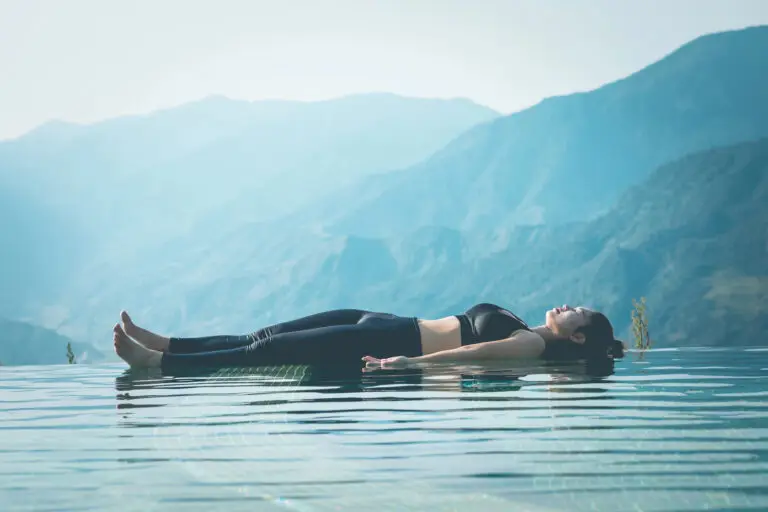
Lie on your back with knees bent, feet on the floor. Place your hands on your ribs. Feel the rise and fall of your breath for a few minutes. As the body steadies, the mind often softens too. This creates the space where new ideas — and new expressions — can emerge.
Each of these practices clears a little more space. Stress loosens. Breath deepens. Expression returns. Creativity isn’t forced,it’s invited.
Everyday Embodied Creativity
You don’t have to stick to yoga practices alone. Creativity can show up in many forms:
- Move to music. Put on a song and let your body sway, stretch, or dance for a few minutes.
- Shape your feelings. Sketch your mood as a line, shape, or color. No art skills required.
These are all ways of giving the body a chance to speak through movement, sound, and simple sketching.
Clearing the Way for Expression
Whether you’re a scientist, an artist, a teacher, or simply someone navigating the weight of daily life, creativity is not optional — it’s how we adapt, connect, and express our truth.
By steadying the nervous system and opening space through body, breath, and sound, embodied practices give creativity room to return.
And when that happens, your voice — in writing, in movement, in song, or in life itself — becomes freer, fuller, and more your own.
References
Colzato, L. S., Ozturk, A., & Hommel, B. (2012). Meditate to create: the impact of focused-attention and open-monitoring training on convergent and divergent thinking. Frontiers in Psychology, 3, 116. https://www.frontiersin.org/journals/psychology/articles/10.3389/fpsyg.2012.00116/full
Lebuda, I., Zabelina, D. L., & Karwowski, M. (2016). Mind full of ideas: A meta-analysis of the mindfulness–creativity link. Personality and Individual Differences, 93, 22–26. https://psycnet.apa.org/record/2016-14379-003
Gura, T. (2018). Yoga and creativity: clearing intrusive thoughts. Frontiers in Human Neuroscience.
Limb, C. J., & Braun, A. R. (2008). Neural substrates of spontaneous musical performance: an fMRI study of jazz improvisation. PLoS ONE, 3(2), e1679. https://pmc.ncbi.nlm.nih.gov/articles/PMC2244806/Koelsch, S. (2014). Brain and music. Wiley Interdisciplinary Reviews: Cognitive Science, 5(6), 547–560.