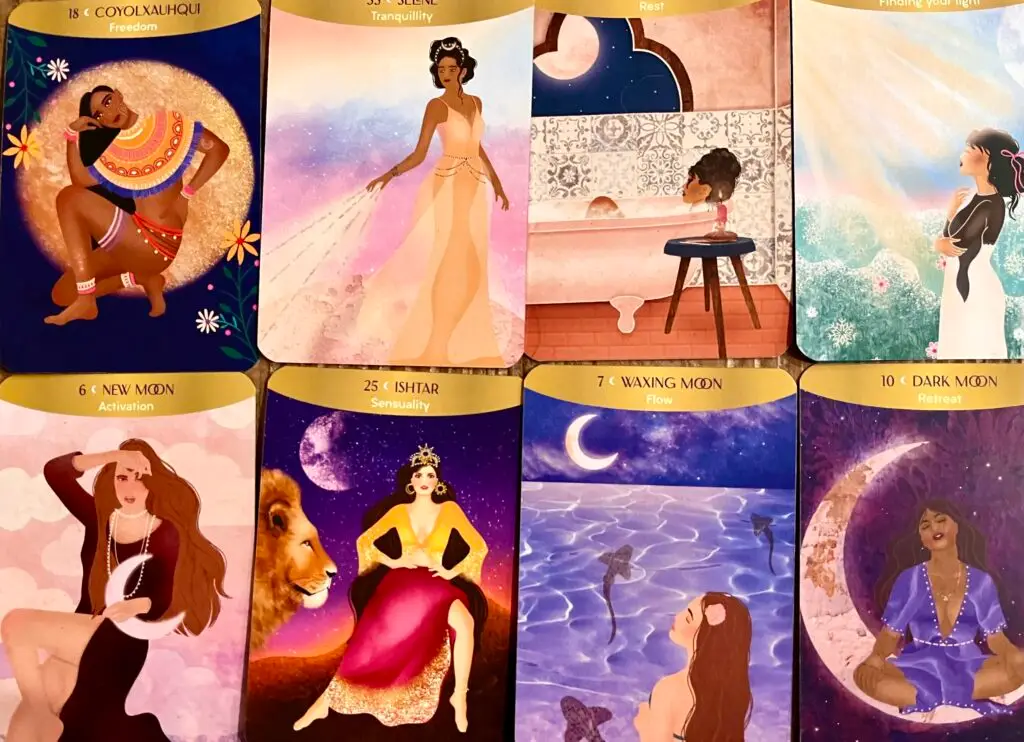

Many people discover oracle decks and wonder how to use oracle cards in a way that feels meaningful rather than overly mystical or complicated.
At first glance, they can seem mysterious — beautifully illustrated cards paired with short phrases about intuition, growth, or guidance.
But in practice, oracle cards are often used in a much simpler way.
For many people, they’re a small tool for reflection.
Pulling a card creates a moment to pause. You look at the image or read the message and notice what it brings up — a thought, a feeling, a memory, or a question that hadn’t quite surfaced yet.
It’s less about prediction and more about attention.
That brief pause — with a cup of coffee in the morning, a few quiet minutes in the sun, or a moment of journaling at the end of the day — can open space for reflection that might not happen otherwise.
At times, it can prompt strong insight about you or your life.
What is an Oracle Deck?
An oracle deck is a set of illustrated cards designed to inspire reflection or insight. Each card usually contains an image, a word, or a short phrase. Many decks also include a guidebook that offers additional interpretations or reflections.
Unlike tarot, which follows a fairly consistent structure and symbolic system, oracle decks are much more open-ended. Each deck is created around its own theme — nature, creativity, personal growth, mythology, or spiritual symbolism.
Because there is no fixed system, people use oracle decks in many different ways. Some approach them as spiritual tools. Others see them as creative prompts. Many simply enjoy the quiet moment of reflection that comes from drawing a card and sitting with its message.
In that sense, the value of an oracle deck is not necessarily in the card itself, but in the pause it creates.
If Oracle Cards Feel Unfamiliar or Uncomfortable
For some people, tarot or oracle cards can feel unfamiliar or uncomfortable. Depending on your background or beliefs, they may be associated with fortune telling or spiritual practices that don’t feel aligned with your values.
That hesitation is understandable.
In the approach described here, oracle cards aren’t used to predict the future or access hidden forces. Instead, they function much more simply — as prompts for reflection.
In many ways, they work similarly to a journaling question, a poem, or a piece of art that invites you to pause and consider what it brings up in your own experience.
Some people enjoy them as a creative or reflective tool. Others prefer different practices for self-inquiry, such as journaling, meditation, prayer, or quiet time in nature.
There’s no single right way to reflect. Oracle cards are simply one option among many.
Why Symbols Can Open Reflection
There is something powerful about encountering meaning indirectly.
A question asked directly can feel confrontational or overly analytical. But an image or phrase invites a different kind of engagement. Instead of forcing an answer, it opens space for association, memory, intuition, or curiosity.
You might look at a card and immediately recognize something in your life. Or you might feel resistance. Sometimes the message lands right away. Other times it unfolds slowly throughout the day.
The card itself does not contain the insight.
It simply opens the door.
Sometimes that door leads to a realization you were already circling but hadn’t quite named yet. Sometimes it leads to a question you hadn’t considered asking. And sometimes it simply invites you to pause long enough to notice what is already present.
The insight comes from that moment of noticing.
A Light Note on Self-Inquiry in Yoga
In yoga philosophy there is a concept called svādhyāya, often translated as self-study. Traditionally, this includes both studying wisdom texts and observing one’s own thoughts, patterns, and reactions with honesty.
Self-study in this sense is not about constant self-analysis or improvement. It is about paying attention. Noticing habits of mind. Becoming more aware of how we respond to life.
Oracle cards are not a traditional yogic practice, and they don’t need to be framed that way. But in a simple sense, they can serve a similar spirit of inquiry: offering a prompt that invites reflection.
The card becomes less of an answer and more of a question.
Creating a Small Ritual Around Reflection
One of the reasons oracle cards resonate with people is that they naturally lend themselves to small, quiet rituals.
Not elaborate ceremonies. Just small moments of attention woven into the day.
People use oracle cards in many ways. Some pull a card in the morning as a reflection for the day. Others keep a deck near their journal and draw a card before writing. Some people enjoy incorporating them into a small ritual — lighting a candle, sitting by a sunny window, or pausing with a cup of coffee while they reflect on the image and message.
These small gestures matter more than they might seem.
Ritual creates a container. It signals to the mind and body that this is a moment set aside for reflection rather than productivity.
The card becomes a doorway into that space.
Oracle Cards as Creative Prompts
Another way to work with oracle cards is through creative exploration.
A single card can become the starting point for a page in a journal, a short piece of writing, a sketch, or even a piece of music. Instead of trying to interpret the card in a fixed way, you simply allow it to spark a response.
You might write freely for ten minutes about the theme of the card.
You might notice what emotions or memories arise.
You might simply sit with the image and see what it evokes.
In this way, the practice becomes less about interpretation and more about exploration.
The card is not something you need to solve.
It is something you can respond to.
Letting Meaning Unfold Over Time
It’s easy to feel pressure to “figure out” what a card means right away.
But sometimes the most interesting insights arrive later. A phrase from the card might echo in your mind during a conversation. An image might suddenly make sense in light of something that happens that afternoon.
Not every card needs to be profound. Some will pass quietly through your day.
But every now and then, one will stay with you.
And that small moment of recognition — that quiet shift in awareness — is often where the real value of the practice lies.
A Simple Invitation to Reflection
At its heart, an oracle deck is simply a collection of images and ideas.
The meaning doesn’t come from the cards themselves. It comes from the relationship you form with them — the questions they stir, the memories they surface, the reflections they invite.
Sometimes all it takes is a small interruption in the usual rhythm of the day.
A card drawn with your morning coffee.
A moment of quiet in the sun.
A question that lingers a little longer than usual.
From there, reflection begins.
In the end, learning how to use oracle cards doesn’t have to be complicated. For many people, the practice is simply about creating a small moment of reflection — a card drawn with morning coffee, a few quiet minutes with a journal, or a phrase that lingers throughout the day. Whether used as a creative prompt, a reflective ritual, or a gentle invitation to self-inquiry, oracle cards can become one more way to pause, notice, and reconnect with what is already unfolding within you.
Continue the Exploration
If this topic resonated with you, you might also enjoy:
Related Articles
- The Meaning Behind Rituals: Why They Matter
- How Modern Somatics and Meditation Can Help You Be More Creative
Expressive Workshops & Programs
Explore guided workshops and group experiences designed to support reflection, creativity, and meaningful self-inquiry.